Game economies and monetization can involve much more than payments for in-game purchases or ads. Creator earnings, player rewards, marketplaces, cash-out and value moving between game currency and fiat all create financial activity inside the game or platform itself. Embedded finance gives publishers the infrastructure to support those interactions as part of the user experience while driving revenue and growth.
Roblox1 Wallet is one of the clearest recent examples of embedded finance entering gaming. With Airwallex providing the payments infrastructure behind the upcoming rollout, it shows how a large creator platform can add financial accounts and fiat payouts to an existing creator economy. But most publishers don’t have Roblox’s decade of creator-payment infrastructure behind them, so they need to assess which approach can best support their own setup.
What Roblox announced with Wallet
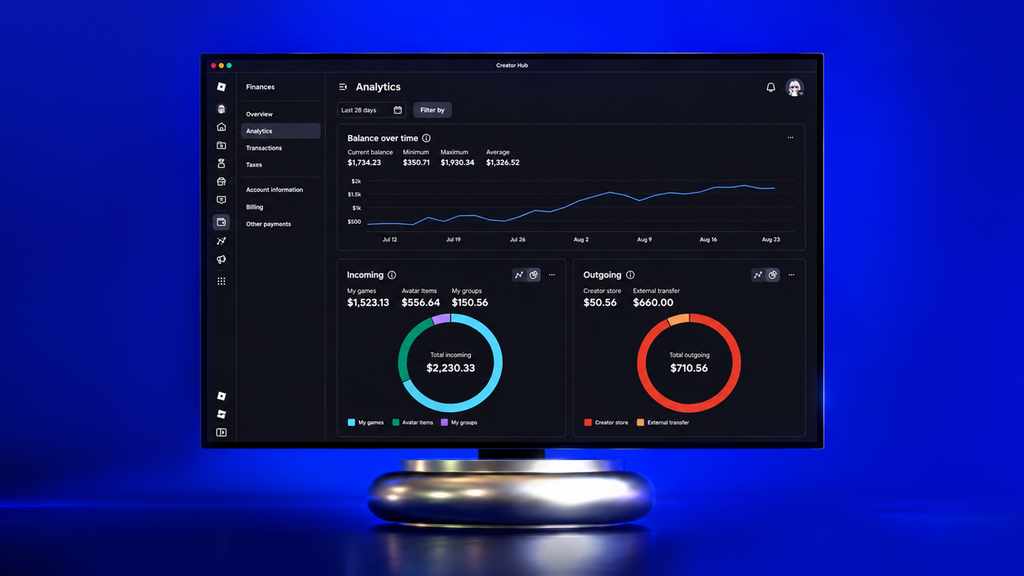
At RDC 2026, Roblox announced Roblox Wallet, a financial account in their Creator Hub for eligible creator businesses. Until now, creators earned in Robux and could request a fiat cash-out through a separate payout process handled via Tipalti, with cash-outs limited to once per month. Wallet brings that experience into Creator Hub, with cleared earnings paid into the account every business day in fiat. Creators can then transfer those funds to a bank account or use them for creator expenses within Roblox. Roblox Card has also been announced, extending faster access to those funds outside the platform. This initial Airwallex partnership provides the regulated payments infrastructure behind both of these upcoming features. Roblox still operates the creator economy itself, while Wallet embeds the fiat account and payout experience into it.
Business payments only solve one part of the game economy
Airwallex has built its platform around the financial needs of global businesses and digital platforms, including e-commerce, marketplaces, SaaS and travel. For this initial partnership with Roblox, that infrastructure brings the fiat account and payout experience directly into Creator Hub.
Creator economies are booming, driven by UGC, modding and other creator activity. But the opportunity extends beyond only servicing creators to also engaging with the whole player base. P2P marketplaces, player rewards, and competitions can move value within gameplay, while players might also want to cash out or spend earnings back in the game.
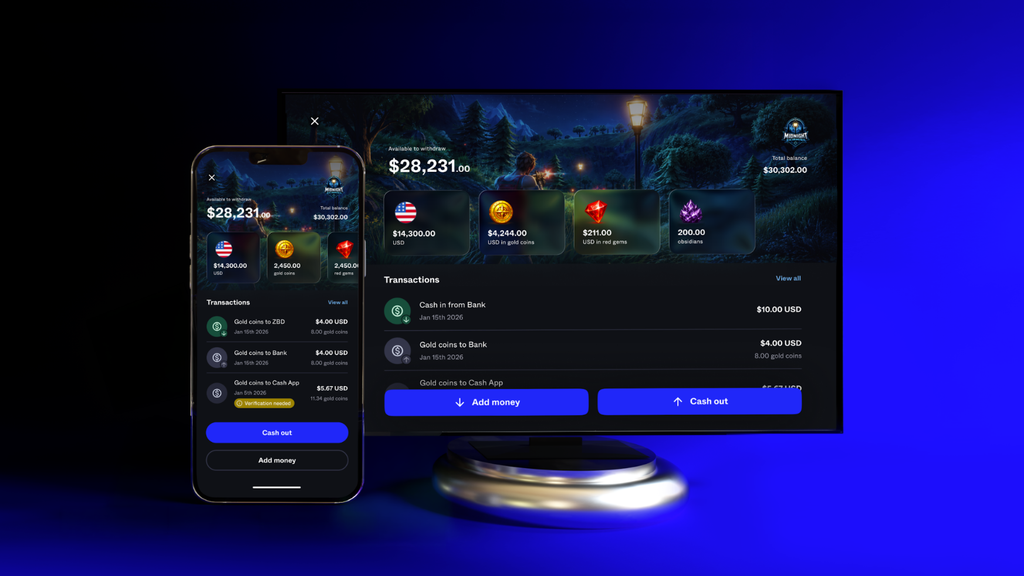
ZBD2 focuses on enabling all these interactions across the money lifecycle, with money moving around the game economy and money moving out of it, providing developers new opportunities. Its infrastructure can support player and creator accounts, game currency and fiat on the same ledger, two-way value exchange, and value moving between creators, players and publishers. For publishers, that can mean deeper financial relationships with users, stronger engagement and loyalty, more reasons for value to stay inside the game, and incremental revenue streams. For example, publishers can earn a 10–15% marketplace commission on eligible P2P transactions that may otherwise happen off-platform.
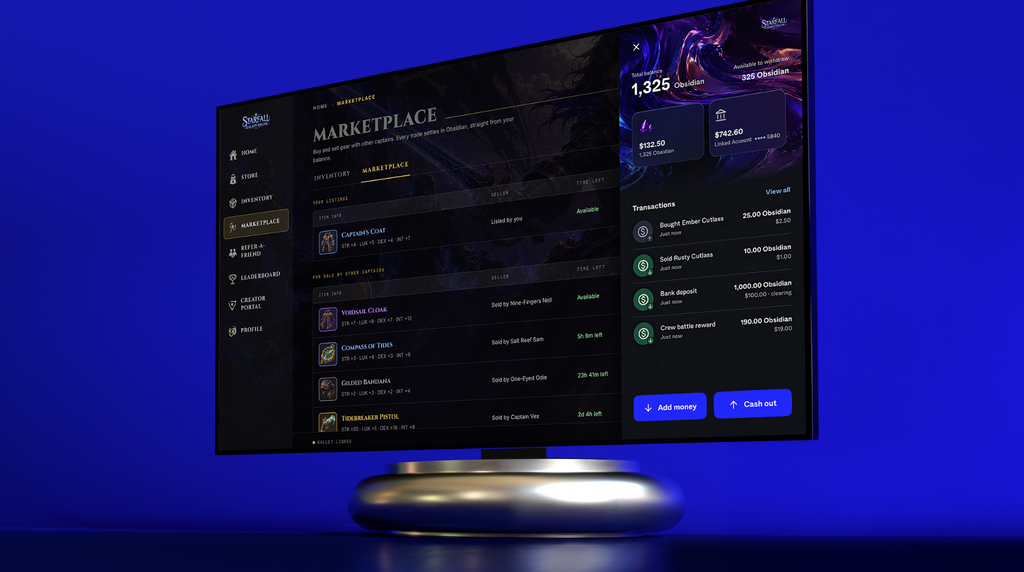
Publishers can choose the components they need, including spend-back into the game and rewards in game currency for everyday purchases. This connects money movement directly to gameplay and other activity on the platform without publishers having to build the regulated payments layer themselves.
Airwallex vs ZBD for games
Airwallex offers more products than Roblox uses today, so this comparison focuses on the current Roblox Wallet and the game-economy use cases relevant to game and creator platforms.
| Airwallex / Roblox Wallet | ZBD | |
|---|---|---|
| What is the wallet for? | Receiving and managing fiat payouts for creator businesses | Supporting player and creator earnings, in-game trading and payouts, with two-way conversion between virtual currency and fiat |
| Who is it built for? | Creator businesses | Players and creators |
| What can it hold? | Fiat balances (current implementation) | Fiat and publisher-defined game currencies |
| What can users do with their balance? | Transfer to a bank, spend on supported Roblox expenses, with Roblox Card for spending outside the platform also announced | Spend back in the game, trade through marketplaces or P2P, or cash out to a bank or other supported methods. Announced branded debit cards can reward everyday purchases with in-game currency |
What should game publishers look for in an embedded-finance partner?
The right setup depends partly on what the publisher already has and how much of the experience it wants to build and control, and whether it is operating a largely closed ecosystem or wants value to to extend across games and platforms.
| Area | What should a publisher ask? | What to check |
|---|---|---|
| Game economy | Can the provider support the economy we want to build? | • Support for fiat and game currency conversion • P2P value movement • Rewards • Ability to spend earned value back in the game |
| Integration | How much will our team need to build and manage? | • REST APIs • Game-engine SDKs • Embedded components and widgets • What the provider handles vs what your team needs to manage, including ledgering and payment configuration |
| Flexibility | Can the solution adapt to the platform experience? | • Whether individual components can be used as needed • How much of the experience and underlying logic the publisher can choose to manage itself |
| Markets & currencies | Can it support the players and creators we need to reach? | • Supported markets, local payout methods, currencies and FX coverage • Whether support is limited to business users or also extends to individual players and creators |
| Creators & businesses | What happens as users earn more or start operating as businesses? | • Identity and business verification • Changing verification requirements • Tax documentation and reporting |
| Regulation & compliance | What does the provider handle, and what remains with us? | • Where the provider is licensed to operate • Who performs identity checks, sanctions screening, transaction monitoring • Which regulatory responsibilities remain with the publisher |
Roblox Wallet shows how embedded finance can bring faster, native fiat payouts into an established creator economy. Publishers without Roblox’s scale or custom systems may need more game economy functionality from their payments partner.
ZBD provides publishers, mod platforms and marketplaces with financial infrastructure for moving value between players and creators through gameplay, creator earnings, marketplaces and other activity across the game economy.
Explore how embedded finance could work in your game?
- Roblox, Robux, Roblox Card, and RDC are trademarks of Roblox Corporation. ZBD is not affiliated with, endorsed by or sponsored by Roblox Corporation. All trademarks are the property of their respective owners. ↩︎
- ZBD is the trading name of ZEBEDEE, LLC and ZEBEDEE Europe B.V., wholly owned subsidiaries of ZEBEDEE Holdings, Inc. In the United States, services are provided by ZEBEDEE, LLC, a money services business registered with the Financial Crimes Enforcement Network and licensed as a money transmitter in most states. In the European Economic Area, services are provided by ZEBEDEE Europe B.V., authorised by De Nederlandsche Bank N.V. as an electronic money institution and registered with the Netherlands Authority for the Financial Markets as a crypto-asset service provider under Regulation (EU) 2023/1114.
Funds held in a ZBD account are electronic money or safeguarded customer funds, as applicable. They are not bank deposits, are not insured by the Federal Deposit Insurance Corporation, and are not covered by any deposit guarantee scheme.
Products and services are not available in all jurisdictions and are subject to eligibility, verification and applicable law.
↩︎