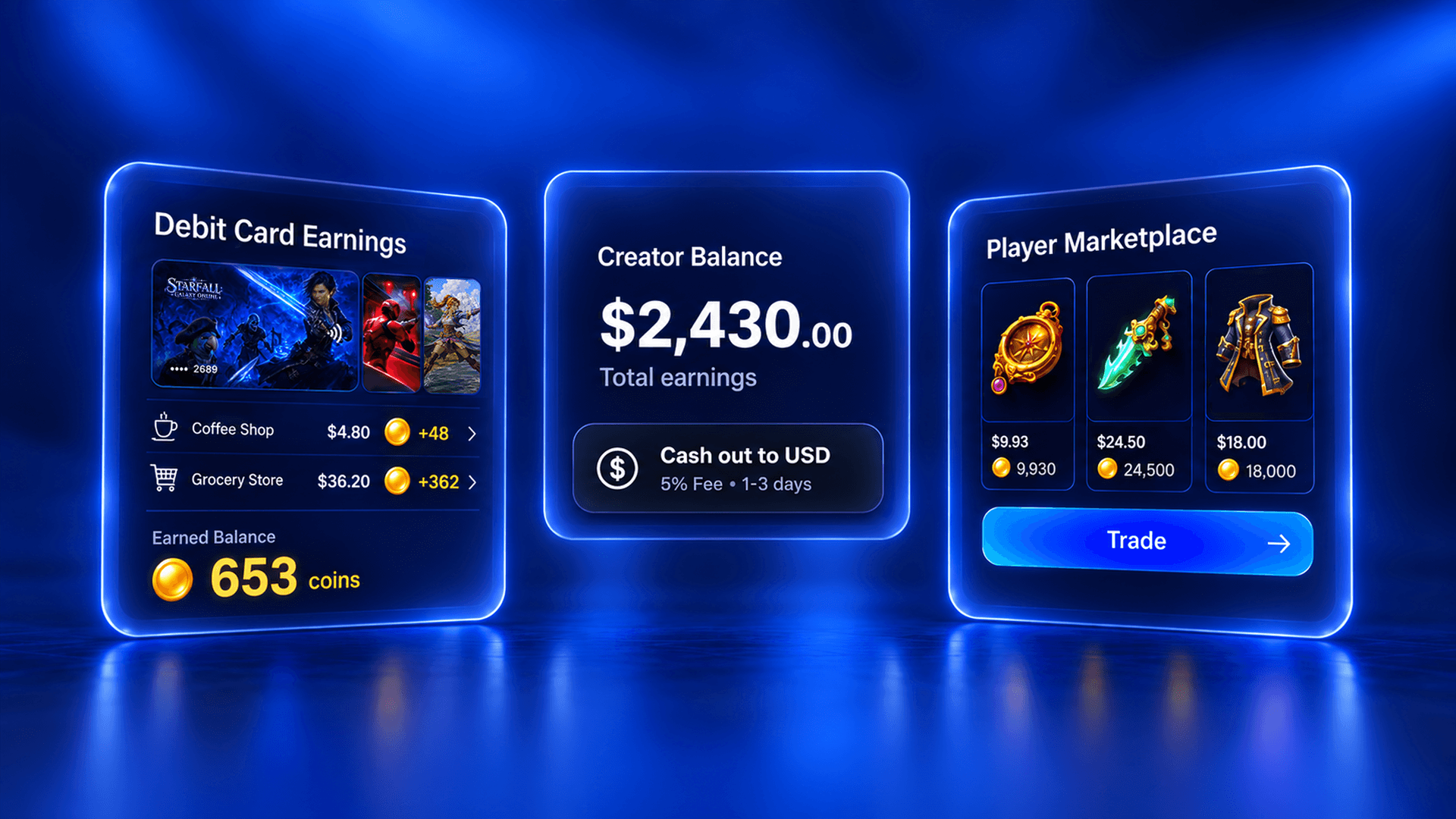
PC/console publishers already monetize through game sales, DLC, cosmetics, subscriptions and battle passes. But there are more revenue streams occurring around games, particularly through creators getting paid and players trading with each other on secondary markets or mod platforms. These are untapped opportunities that lie in connecting everyday consumer spending back to the game economy.
Embedded financial infrastructure built for game environments gives publishers more ways to capitalize on these opportunities without having to build and operate the regulated payments layer themselves.1 The commercial upside is incremental: reduce costs already being incurred, create new transaction revenue and convert existing player loyalty to new sources of value.
Embedded Payouts: boost engagement and reduce cost, while giving creators more flexibility
Payment volumes from creator programs can be substantial, particularly for publishers operating UGC ecosystems, affiliate programs, esports competitions or other programs where users earn money. Traditional payout setups, with their accounts payable background, can involve fixed schedules, minimum thresholds, external portals and costs that sit with the publisher regardless of how the creator gets paid.
Embedded Payouts provide a different creator payout experience. Payouts are inside the game or platform so creators never leave the environment where they earn. This can significantly reduce the number of steps required to set up and receive payments, a win-win for both the publisher and creator.
Minimum payout thresholds are common in traditional setups and can leave smaller creators unable to access what they’ve earned. In one large creator program, more than 65% of creators with earned balances never reached the amount required to cash out. Embedded payouts are designed for the long tail of creator earnings, with payouts as low as $5 supported. That helps more creators receive their first payment sooner, reducing frustration and giving them more reason to keep participating.
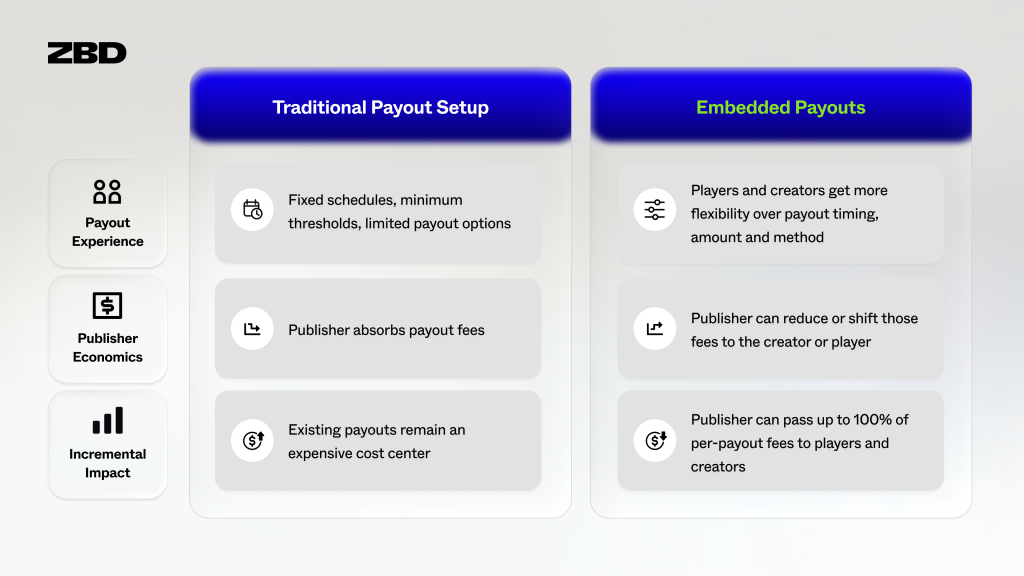
Embedded Payouts also give publishers more flexibility in how payouts are offered to the creator. The key change is that the publishers let players and creators choose the payout method and timing that works for them. They can choose between faster, more convenient payout options at a higher cost or lower-cost options that may take longer. Because the choice rests with the users, they incur the fees based on their decision.2 The publisher-funded payout fee, typically around 5-8%, shifts to the creator or player, which can save the publisher up to 5-8% of annual payout volume.
Embedded Accounts: turn P2P activity into a revenue stream
Large-scale PC and console ecosystems often see significant player-to-player trading in skins, virtual items, currencies and other permitted digital goods. In some cases, this activity takes place through external or unregulated secondary markets, where the publisher has limited visibility and earns nothing from those transactions directly. A 2021 Naavik and BITKRAFT estimate put unofficial trading at $11.5B annually, illustrating the scale of economic activity taking place outside publisher-controlled channels.
Embedded Accounts enable publishers to bring that transaction activity into their own environment by adding regulated fiat balances alongside the virtual currencies they already operate. Players can fund a balance and use it for P2P trading, gifting and other marketplace activity directly inside the game, then reinvest what they earn in the game or cash out through supported methods.
For the first time, assets that players amass in a game can have real-world value that is tradable directly in-game. That matters because behavioral research suggests this can lead players to contribute more to the game by buying more content with virtual currency and playing longer. Both are key commercial objectives of any game or platform, but as established game mechanics start to fatigue, Embedded Accounts offer a new type of solution that can act as an additional lever of growth.
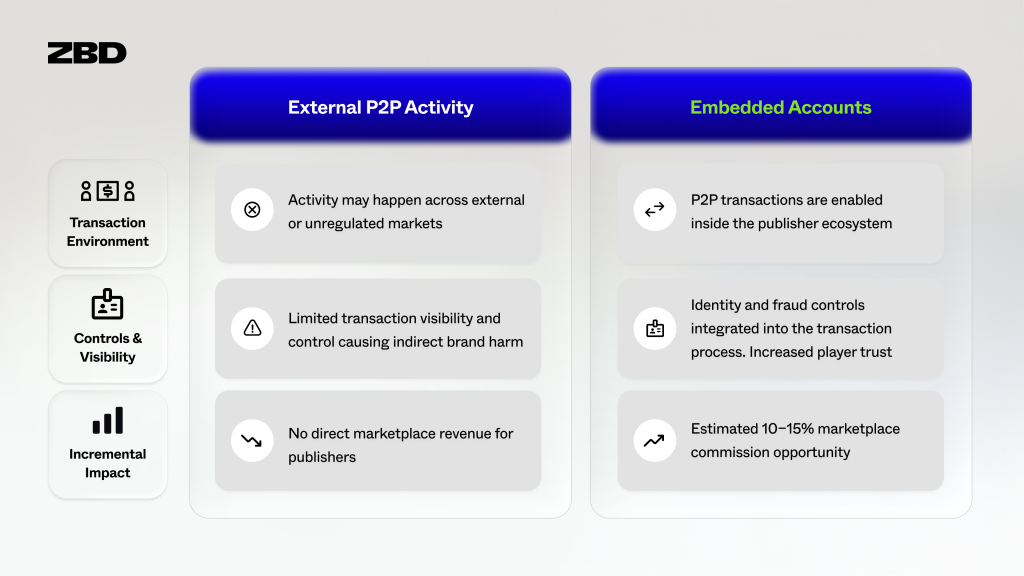
Once P2P trading is enabled within a game, the publisher can earn a 10–15% marketplace commission on each eligible transaction, creating new, incremental revenue from trading that would otherwise happen off-platform. Keeping the marketplace inside the game also gives the publisher more control over the experience, with identity and other required controls built into the regulated setup. That can reduce fraud and customer issues, improve the quality of interactions between users, and limit the reputational risk that comes with trading on external sites.
Branded Prepaid Debit Cards: connect everyday spending to game loyalty
Branded prepaid debit cards can connect everyday spending back to the game, creating an additional loyalty and revenue channel for publishers.
Players use the card for normal purchases such as groceries, subscriptions or entertainment. Publishers can offer players a configurable, white-label prepaid debit card, while ZBD manages the card program and currency conversion together with issuing partners and card networks.
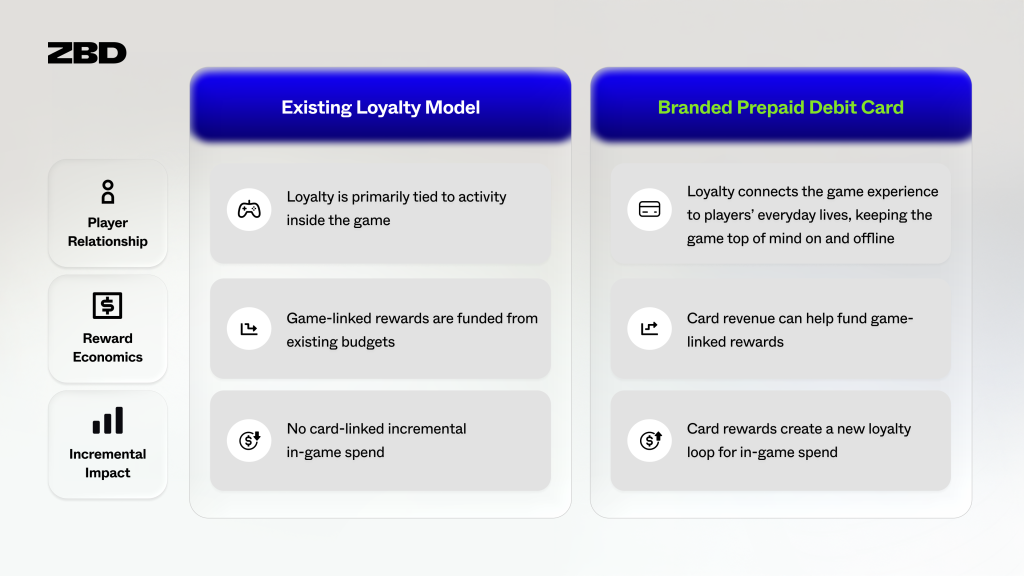
At an illustrative 1–2% publisher share of card spend, even ~1% card adoption for a game with 10M MAU could generate roughly $5–10M in incremental annual card revenue.3 A portion of that revenue can help fund game-linked rewards,4 which can in turn encourage additional in-game spend.
Three ways publishers will gain incremental value
These opportunities span multiple areas of the publisher’s business, each with a distinct commercial impact.
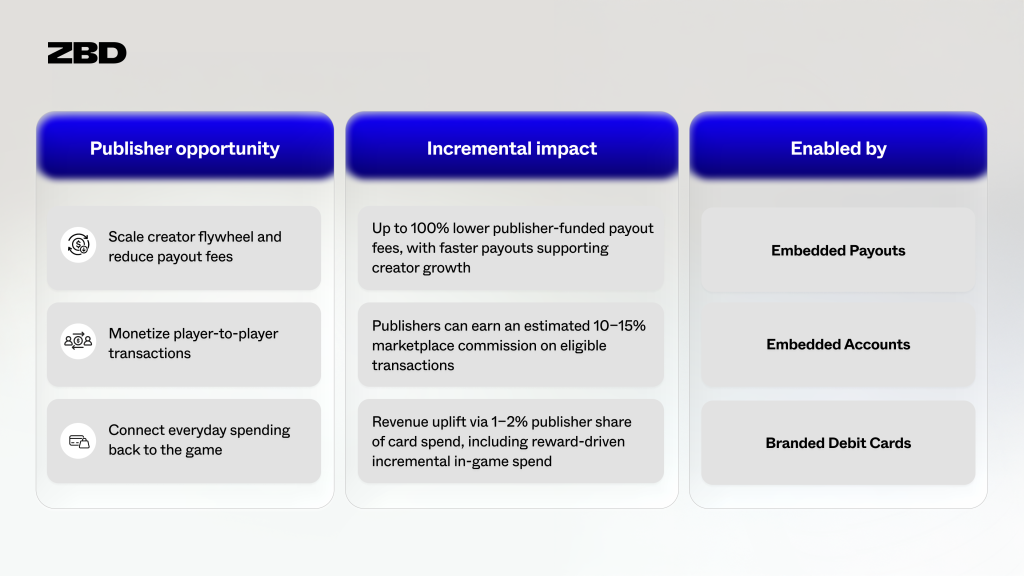
Together, they give publishers additional levers for revenue growth, margin improvement and cost efficiency.
What could this look like for your game economy?
- Availability varies by market and by product and is subject to licensing, eligibility, identity verification and minimum age requirements; some features described above are in development or in limited release. ↩︎
- Rewards and cash-out are available only to verified users who meet the applicable minimum age and eligibility requirements in supported markets. ↩︎
- Illustrative estimate based on 10M MAU, 1% card adoption, $450 average monthly card spend and a 1–2% publisher share of card spend. Actual results will vary based on adoption, card usage, commercial terms and market availability. ↩︎
- Funds are held as electronic money and safeguarded in segregated accounts at a licensed credit institution; they are not bank deposits and are not covered by FDIC insurance or any deposit guarantee scheme. ↩︎