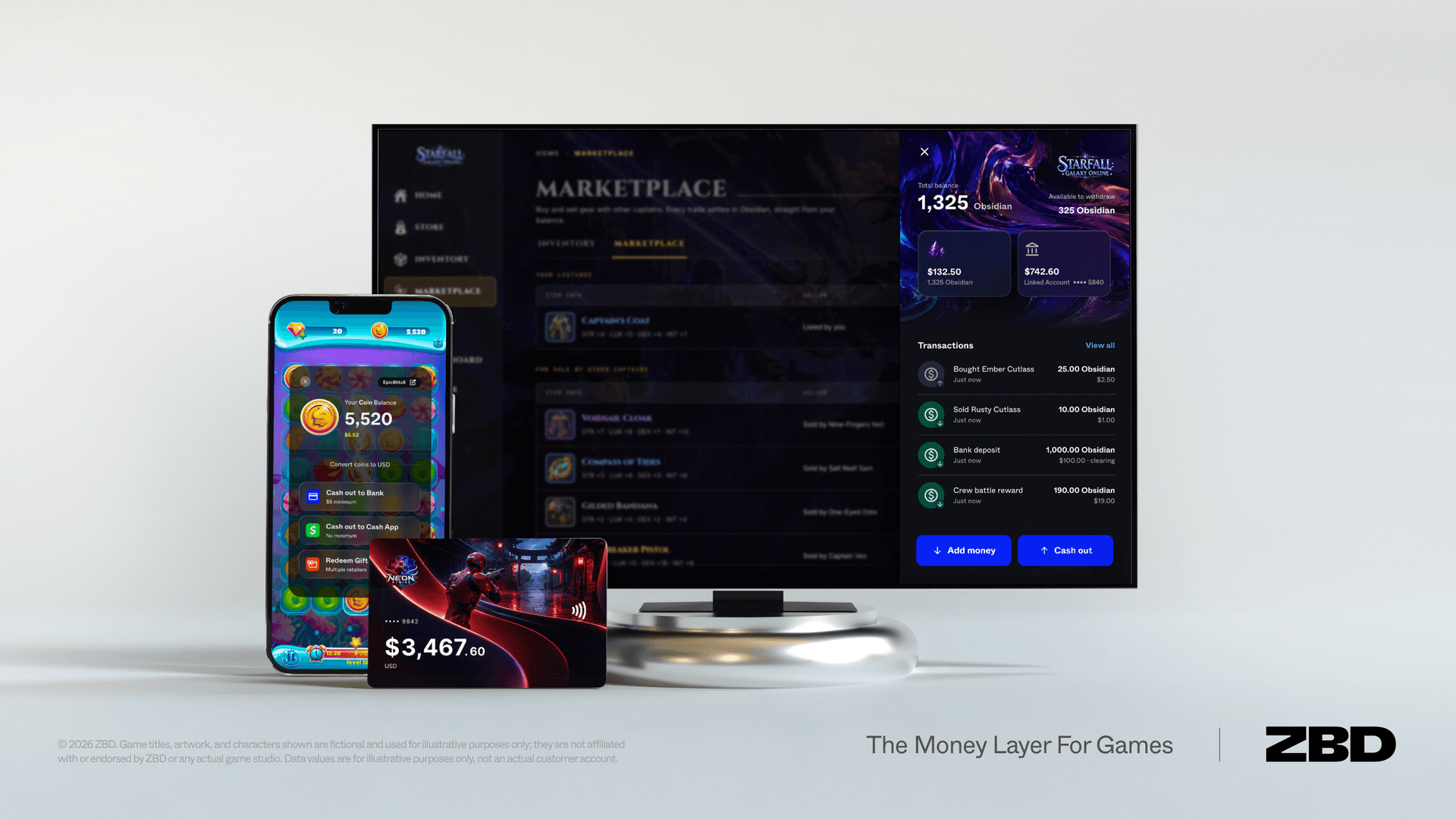
We’re introducing our embedded financial infrastructure for games, giving studios a single platform to power the full money lifecycle. The payments stack brings together Embedded Accounts, Embedded Payouts, Embedded Rewards and Branded Debit Cards. ZBD enables player pay-ins, P2P marketplaces, creator economies, gameplay rewards, player and creator payouts, loyalty programs connected to real-world spending, and more.
The product suite embodies ZBD’s mission of disrupting and innovating gaming payments with game-native approaches across mobile, PC and console. Studios can keep more financial activity within their own game environments while gaining greater control over how value moves between their games, players and the real world.
Why game economies need their own financial infrastructure
Money already moves through games in different ways, but often it isn’t done in the most effective way. Players fund accounts and trade value, creators earn from their communities, and tournaments and esports competitions distribute winnings.
However, the infrastructure behind these flows is often fragmented or retrofitted from other industries. Different providers may handle pay-ins, payouts, compliance and other parts of the transaction flow, while some player-to-player and marketplace activity takes place outside the publisher’s ecosystem altogether. That fragmentation can create operational complexity for studios and friction for players. Payouts may send users to external platforms, creator and P2P transactions can move to unregulated secondary/grey markets, and supporting new financial use cases means adding further integrations and compliance requirements.
ZBD embeds this functionality as a single money layer built for games, allowing financial activity to become part of the game experience itself. That layer spans the three stages of the money lifecycle:
- Money in: players fund their in-game balance directly, without leaving the game.
- Money through: value moves between players, marketplaces and creator economies.
- Money out: players and creators cash out through supported payout methods.
Together, these flows create a two-way value exchange between the game and its players, with studios retaining greater control over the financial relationship.
The ZBD stack: four ways to build money into the game
The full stack brings embedded accounts, payouts, rewards and branded debit cards together across the full money lifecycle in games.1 The video below shows how the money layer fits together.
Embedded Accounts

Players can fund a licensed financial account embedded directly in the game, transact with other users, participate in player-to-player marketplaces, receive creator earnings and cash out through a supported bank account or card.2
Game currencies can also connect with real-world value, allowing studios to design financial flows and new monetization features around their existing economies.
This is particularly relevant for PC and console games with established marketplaces, creator communities or player-to-player trading. Transactions that would otherwise happen through third-party services or unregulated secondary markets can take place within infrastructure controlled by the studio, helping retain revenue while giving players a more transparent transaction experience.
Embedded Payouts

Games need to make payments across a range of use cases, from player rewards to creator earnings, referral payouts and esports prizes. These payments can happen at any time and at very different volumes and denominations, requiring infrastructure that can keep pace with the speed and scale of modern games.
Embedded Payouts is purpose-built for these environments, supporting fast, on-demand payments directly within the game through a single integration. Studios can offer bank transfers, Cash App, gift cards, push-to-card and other supported payout methods, giving users flexibility over how and where they receive their money while keeping the cash-out experience within their own product.
That builds on capabilities such as ZBD’s direct Cash Out to Bank. Instead of integrating and managing separate providers for different payout methods, studios can support multiple options through the same infrastructure. That allows developers to focus on the experience they want to build around the payment.3
Embedded Rewards

Embedded Rewards brings real-world monetary value directly into gameplay, allowing studios to reward users for the actions that matter within their game.
Rewards can be linked to progression, milestones, LiveOps events and other gameplay actions, with reward journeys configured around different user segments and lifecycle stages. They can appear through the game’s existing UI, with the real-world value of the reward shown to the player.
The model is designed to layer on top of existing monetization and game economies. By rewarding actions that increase session frequency and engagement, studios can use cash-value incentives designed to strengthen retention and LTV while generating more value from their existing ad and IAP monetization.
Cash out remains part of the native experience, with the licensed payments infrastructure handled behind the scenes.4
Branded Debit Cards

Branded Debit Cards extend player loyalty beyond the game by connecting everyday spending back to the game economy. Studios can offer configurable, white-label prepaid debit cards with rewards paid in in-game currency or other game benefits when they make real-world purchases.
This way, everyday spending on things like gas, groceries or streaming subscriptions can create another reason to engage with the game.
Studios control reward rates, exchange rates, spend parameters and card branding, allowing the program to reflect the economy and experience of the individual title. Cards can also be added to Apple Pay and Google Wallet where supported.5
For studios, this creates a way to keep the game top of mind between sessions while encouraging further in-game activity and spend.
ZBD manages the card program and currency conversion together with our issuing partners and card networks.
One money layer for game economies
These products sit on the same underlying financial infrastructure rather than requiring studios to assemble separate systems for each use case.
ZBD operates the regulated payments layer beneath these products. For the accounts and payouts we provide, ZBD performs customer due diligence, sanctions screening and transaction monitoring, and operates fraud controls and payout processing. Studios remain responsible for their own regulatory obligations, including any arising from their game’s mechanics.
In the EEA (European Economic Area), payment and e-money services are provided by ZEBEDEE EUROPE B.V., which is authorized by De Nederlandsche Bank N.V. (DNB) to operate as a licensed electronic money institution (EMI) and a payment service provider and is also authorized by the Dutch Authority for the Financial Markets (AFM) and operates as a licensed entity under MiCAR framework.
Outside of the EEA, services are provided by ZEBEDEE, LLC (NMLS ID 2188007), which is registered as a money services business (MSB) with the U.S. Department of the Treasury’s Financial Crimes Enforcement Network (FinCEN), and holds Money Transmitter Licenses (MTL) across most states in the US. Services are available only where ZBD is licensed or otherwise not prohibited from doing business.
The stack is also designed around the specific technical requirements of games. It supports on-demand processing, programmable money flows and very small-value transactions, including payments at fractions of a cent. These capabilities allow studios to build financial mechanics around individual gameplay actions and high-volume game economies without treating payments as a separate experience.
The result is one money layer that can support everything from a small gameplay reward to a creator payout, marketplace transaction or player account.
Studios are already building with ZBD
ZBD’s existing rewards and payouts infrastructure is already live across more than 60 games, with game teams using the infrastructure across rewarded engagement, payouts and other financial use cases.
Studios and publishers working with ZBD include 1047 Games, Joygame, Udo Games, Turborilla and TapNation, spanning mobile, PC and console.
The existing embedded rewards product also provides a clear example of what happens when financial mechanics are integrated directly into gameplay. After TapNation introduced embedded rewards into Idle Bank, the title recorded a 142% uplift in D14 retention and a 44.4% increase in ARPDAU.6 For more examples from live games, explore our case studies.
For Turborilla CEO John Wright, the opportunity comes from connecting player economics more directly with engagement:
“Retention is critical for games to succeed today, and game publishers need to start looking beyond legacy growth playbooks to boost LTV and long-term profitability. ZBD is one of the few companies building for that future by weaving together payments and player engagement.”
From embedded rewards to the full financial relationship
Embedded rewards demonstrated how sharing real-world value with players can improve the economics of a game. ZBD’s full payments stack applies that same principle across a much larger part of the player relationship.
Money movement can become another part of how studios design engagement and monetization. Instead of financial interactions sitting outside the game experience, game teams can build them around the same players, currencies, communities and behaviors that already power their economies.
As Gordon Thornton, CCO at ZBD, explains:
“Studios can now evolve their financial interactions with players, turning a one-way relationship into a two-way loop that drives engagement, revenue, and loyalty.”
That two-way relationship is the foundation behind ZBD’s full stack: financial infrastructure built around how games and their economies actually operate.
Meet ZBD at Gamescom 2026
We’re unveiling our expanded embedded financial infrastructure at Gamescom 2026. If you’re exploring new ways to build payments, payouts, rewards or player financial experiences directly into your game, meet the ZBD team at Gamescom or get in touch to discuss what the infrastructure could support for your title.
Ready to add the money layer into your game?
- Availability varies by market and by product and is subject to licensing, eligibility, identity verification and minimum age requirements; some features described above are in development or in limited release. ↩︎
- Funds are held as electronic money and safeguarded in segregated accounts at a licensed credit institution; they are not bank deposits and are not covered by FDIC insurance or any deposit guarantee scheme. ↩︎
- As the regulated payments provider for the accounts and payouts we supply, ZBD performs the customer due diligence, sanctions screening and transaction monitoring those services require, and operates the underlying payout processing. Publishers remain responsible for their own regulatory obligations, including any arising from their game’s mechanics. ↩︎
- Rewards and cash-out are available only to verified users who meet the applicable minimum age and eligibility requirements in supported markets. ↩︎
- Apple Pay is a trademark of Apple Inc. Google Pay and Google Wallet are trademarks of Google LLC. Cash App is a trademark of Block, Inc. All other marks are the property of their respective owners. This page is not directed at consumers in the United Kingdom. ↩︎
- Performance depends on the game, the market, the reward design and the player base, and is not a prediction of results for any other title. ↩︎