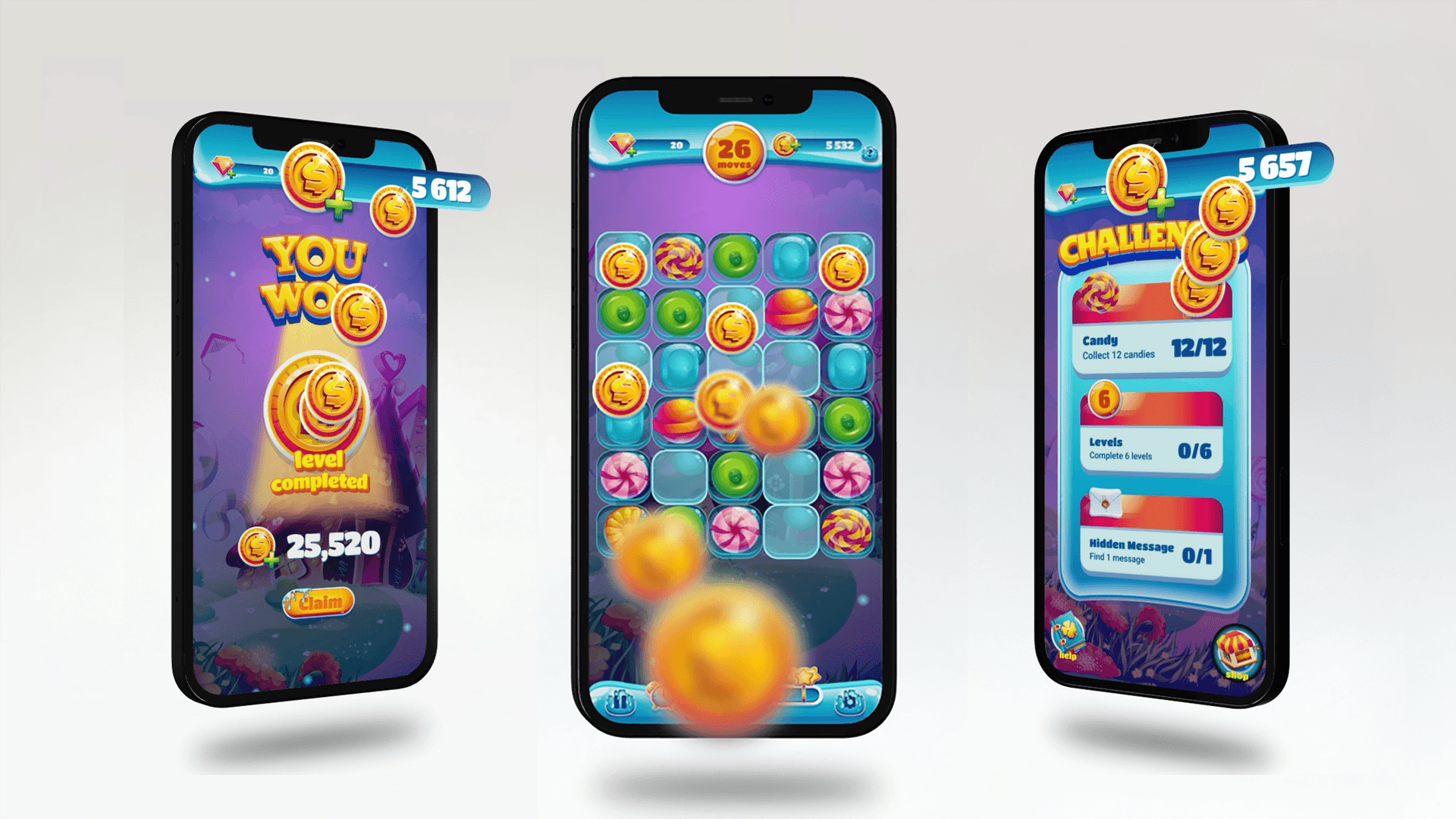
For years, mobile game growth meant one thing: acquire more users. But nowadays installs are slowing, as UA costs are rising, and the games pulling ahead aren’t necessarily acquiring more; they’re heavily focused on keeping who they have.
And yet, many reward systems haven’t caught up to this new reality. They are still designed for acquisition, and positioned outside the game loop, limiting their impact to a small subset of users.

Why Reach Determines Impact
User acquisition still plays an important role. But exponential growth today is more driven by how users behave inside the game, how often they return, how long they stay, and how deeply they engage (and spend).
As Javier Ferreira, co-CEO of Scopely, recently put it, “About 80% of our revenue comes from people that have been playing our games for more than a year.”
Given Scopely’s variety of chart-topping titles, that’s not a one-off data point. It reflects a broader shift in how mobile games generate value. Users are investing more time in the games they already play. That’s because they know their time and attention are valuable. Investing in time is a win-win for games and users. When games tie real-money rewards to the users’ gameplay, the cost of leaving increases. Users could be, literally, leaving money on the table. Plus with so many apps and games competing for their attention, users can be hesitant to try anything new when they’ve already invested time elsewhere.
Rewarded UA incentivizes users through external reward platforms, where attention is spread across many different games and apps. The reward relationship belongs to the platform, not the game itself, which as a result fragments engagement and weakens long-term player loyalty. Plus, as a marketing channel, the impact only targets a small portion of new users. Embedded rewards, like ZBD Earn, are built into the UI, tied to progression, and triggered by in-game actions. Rewards are earned, tracked and paid out in-game, without external platforms.
The reward effect for the play becomes a straightforward natural part of the gameplay experience for the whole active user base.
When time spent in-game carries real-world, tangible value, users build a stronger loyalty to the game itself, which draws them back to engage and advance further in the gameplay.
The math makes this concrete
Let’s take a hypothetical mobile game, where the modeled uplift from rewards aligns with similar performance we’ve achieved with our partners:
- Baseline ARPU (non-rewarded users) is: $1.00
- ARPU uplift with Rewarded UA: +44% ($1.44 ARPU)
- Share of rewarded UA users: 15%
Now calculate the blended ARPU across the entire user base:
- 85% of users generate $1.00 → $0.85
- 15% of users generate $1.44 → $0.22
The total blended ARPU is $1.07, which is a +6.6% increase overall.
At first glance, a 44% rewarded UA ARPU uplift sounds significant. But when it’s only applied to a small cohort, it barely moves the needle.

From cohort uplift to entire user base growth
Now let’s move rewards into the game loop. Instead of sitting outside as an acquisition mechanic, they are embedded directly into the gameplay and tied to progression.
Using the same baseline:
- Baseline ARPU: $1.00
- Embedded rewards ARPU Uplift: +44% ($1.44 ARPU)
Unlike rewarded UA, embedded rewards can be configured across your entire active user base, or targeted by segment. For this example, we’ll apply it broadly to 90% of players.
Total ARPU = $1.44
However, the 44% ARPU uplift here affects all users, not only the new acquired ones.
A smaller per-user uplift across the full or a controlled segmented user base drives far more impact than a larger uplift applied to a small non-controlled subset. Embedded rewards increase frequency and session time because they are directly tied to gameplay across progression, LiveOps events, login bonuses, and more. As users return more often and spend more time in the game, they naturally progress further, interact more often with the games’ ads, and potentially make in-app purchases.
Studios that integrated embedded rewards into their games and linked rewards directly to users’ behavior are seeing incremental ARPU and real results:

Rewards are more than a UA tool
In mobile gaming, rewards are still widely associated with acquisition, while in reality, rewards go way beyond that. In fact, the “rewarded play” category has evolved into a broader growth lever. Let’s break them down to distinguish the different concepts of rewards:
Rewarded UA
This is a user acquisition tactic that sits outside the core gameplay experience, often relying on a 3rd party rewards app. It typically targets specific users through incentivized campaigns. Its impact is therefore limited in scope to those new users who opt in, rather than the game’s full user base, and is only as flexible as the host app. While effective for driving initial engagement or reactivation, it operates separately from the game’s core engagement mechanics.
Embedded Rewards
This is a specific implementation of rewarded play, where rewards are natively embedded within the game, configurable across user segments, and integrated directly into the player experience. Players can cash-out without leaving the game. The important distinction isn’t the reward itself, it’s where it lives and how broadly it applies to users.
Once rewards move inside the game loop, they start becoming a part of the core gameplay and economy while directly supporting how the game retains and monetizes users.
Why it works: shifting user behavior
Embedded rewards transform how players experience value, and creates a long-term two-way value exchange. Studios are seeing 80-200% return on investment when rewards are embedded, with clear impact on LTV.
TapNation is a great example. They integrated rewards into their core gameplay, expanding beyond only treating it as a marketing layer. When rewards sit outside the game, they tend to feel transactional. When they’re embedded, they become more experiential. Rewards reinforce actions players are already motivated to take. It negates the typical one-way flow of players just giving studios money and users now receive something meaningful back through gameplay itself. The result is a stronger connection between the player and the game, where time spent in-game carries visible, tangible value. This motivates the player to keep coming back, ultimately creating more revenue streams for the studio.
“Embedded rewards remove friction by making the reward system part of the core experience. Anything with real monetary value resonates far more than in-game currencies or cosmetic items.”
– Igor Melniks, SVP, Business Development, ZBD
Read the full article to see the thinking behind TapNation’s integration.
From bolt-on to built-in
Bolt-on rewards, like rewarded UA, made sense when growth was primarily dependent on acquisition, but that reality has changed. Today, growth is more determined by what happens after the install. That means rewards that are designed to influence only a small subset of users will always fall short.
Meanwhile, rewards that are embedded into the core experience are designed to strengthen every session and compound across retention, deeper engagement, to improve the overall game monetization. Therefore, they increase LTV across the entire user base.
Curious what this could look like for your game? Let’s talk.
Please note: This article is a marketing communication. The performance data referenced is drawn from actual results observed by existing ZBD customers using embedded rewards. Individual results may vary, and past performance is not a guarantee of future or comparable outcomes.